
Specifying the right external weather louver is an engineering decision that balances two opposing...
The Alupro guide to louver performance classes (EN 13030)
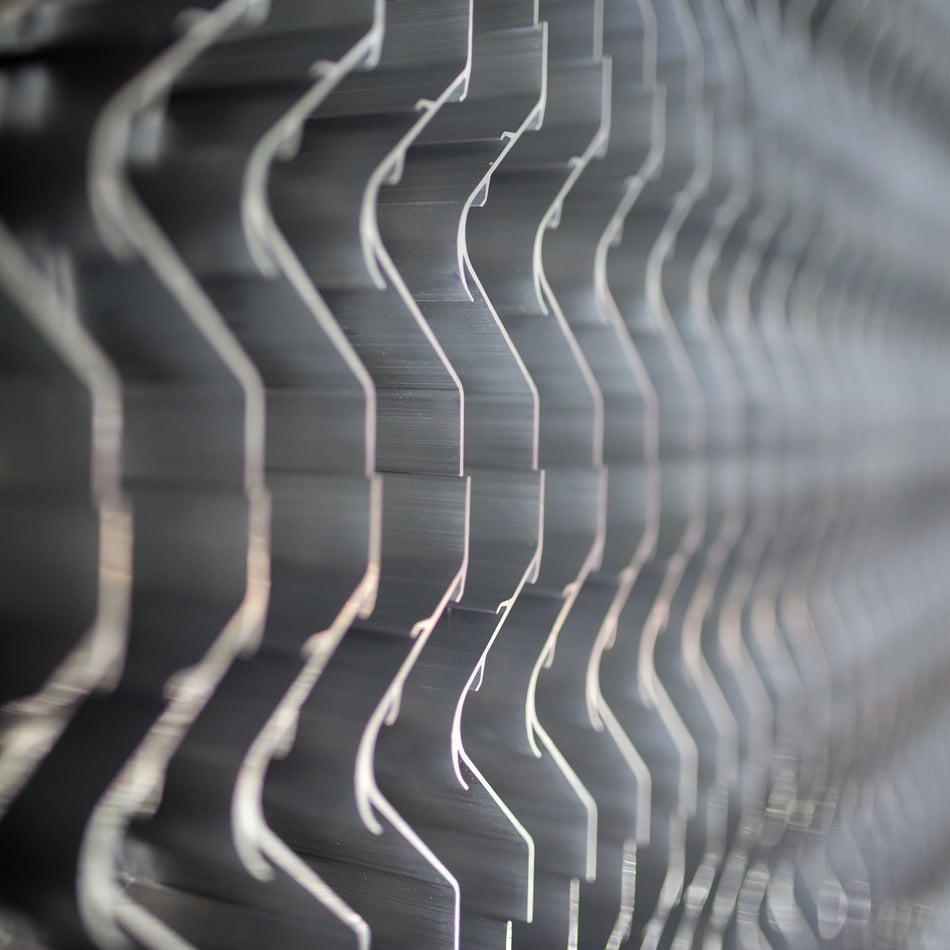
Water ingress is a primary threat to building and equipment integrity. Even a minor leak in an air intake can cause catastrophic damage, compromising structures, destroying equipment, and fostering unhealthy indoor environments. Air intake and exhaust points are particularly vulnerable as necessary breaches in the building envelope. The engineering challenge is to permit free airflow while blocking rain. High-performance weather louvers are designed to solve this problem.
To ensure a louver performs as specified, objective, verifiable data is required. The weather louver testing standard, EN 13030, was established to provide this. It offers a rigorous, common methodology for evaluating water ingress prevention, enabling direct product comparisons.
As the engineers who design and manufacture these solutions, we use this standard daily to validate our designs and guide our clients.
What is the EN 13030 Weather Louver Testing Standard?
EN 13030 is the harmonized European standard specifying the method for measuring and classifying a louver's performance against rain penetration under simulated wind conditions. Instead of a simple pass/fail grade, it establishes a detailed performance hierarchy.
The standard assesses two critical metrics:
- Water Rejection: How effective is the louver at stopping wind-driven rain from passing through it?
- Airflow Performance: How much resistance does the louver create to the airflow? (Also known as pressure drop).
By standardizing classifications for both metrics, EN 13030 enables engineers and building owners to select a product with predictable performance tailored to their project's specific demands.
Decoding the Performance Classes: From Class D to Class A
A louver's water rejection is graded into four classes from D (lowest) to A (highest), determined by its effectiveness across a range of simulated core air velocities.
In our experience, selecting the correct class is the most critical step in louver specification. A common mistake is using a lower-class louver in a critical application to save on initial cost, only to face expensive water damage later.
Class A
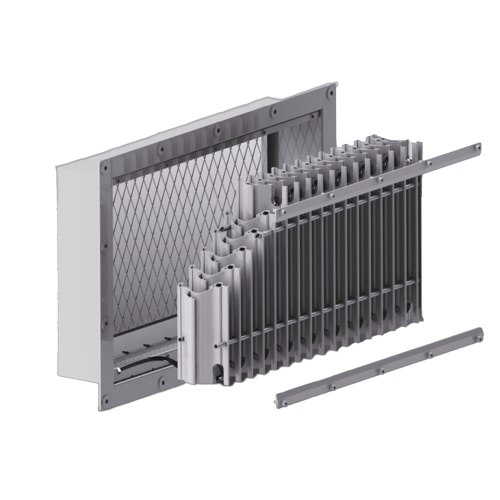
Class A represents the pinnacle of performance. A louver like our WSX High Performance Droplet Separator achieves this class, capable of filtering up to 99.9% of airborne water droplets. These are specified for the most demanding projects where failure is not an option.
Class B and C
Class B and C are the standard specifications for many commercial and industrial buildings, offering a solid balance of performance and cost for less critical applications.
Class D
Class D louvers have their place, but it's crucial to know their limitations. They are often simple pressed-blade designs that offer aesthetic screening but minimal weather protection. They are appropriately used on structures like parking garages, but specifying one to protect sensitive equipment would be a serious design flaw.
How the Test is Performed
The value of an EN 13030 rating is rooted in the rigor of the test procedure.
The test is conducted in a specialized chamber where conditions are precisely controlled:
- Setup: A sample of the louver (typically 1m x 1m) is installed in the test rig.
- Simulated Rain: Water is sprayed onto the face of the louver at a constant rate of 75 litres per hour per square metre.
- Simulated Wind: The test mimics a strong gale by applying a 13 m/s wind to the louver's face. Simultaneously, air is drawn through the louver at progressively increasing core velocities to measure water penetration at different airflow rates.
- Measurement: At each wind speed increment, the amount of water that penetrates the louver is carefully collected and measured.
The final classification is based on performance across this entire velocity range. We validate our technical louvers and droplet separators through this process at accredited independent institutes, such as the VTT Technical Research Centre of Finland.
Airflow Performance: The Other Half of the Equation
Water rejection is only half the story; a louver must also permit adequate airflow. The second key metric of EN 13030 is the discharge loss coefficient, which quantifies the louver's resistance to airflow, classified from 1 (very low resistance) to 4 (very high resistance).
Superior louver design is defined by achieving both a high water rejection class (A or B) and a low airflow resistance class (1 or 2). Engineering this performance combination is what distinguishes high-performance products from standard ones.
Alupro's Approach: Matching the Right Louver to the Project
No single louver is right for every application. The ideal solution depends on the project's location, function, and risk tolerance. Our team helps clients navigate these variables to determine the correct specification.
We don't just provide a catalogue. We partner with HVAC engineers and project managers during the design phase to analyze the requirements. For a coastal data center or offshore platform in demanding northern conditions, we would unequivocally recommend a Class A droplet separator made from marine-grade aluminum or stainless steel. Because we manufacture every louver to measure at our own facility, we can tailor the material, finish, and dimensions to the project's exact needs.
Don't Settle for Uncertified Performance
The EN 13030 standard provides the essential framework for making informed decisions on weather protection. By understanding the performance classes for both water rejection and airflow, you can specify a louver that not only protects your building from water damage but also contributes to its energy efficiency.
Our recommendation is simple: always ask for the certified EN 13030 classification. A cheap, unrated louver is a risk that can lead to immense costs down the road. Contact our team to discuss your specifications.
Frequently Asked Questions
What is the difference between a weather louver and a droplet separator?
A weather louver provides general rain defense. A droplet separator, like our WS-series, is a high-performance device with complex internal blade channels designed to capture and drain airborne water droplets. This makes it essential for critical applications like marine environments or protecting sensitive equipment.
Does a Class A louver block all water?
Class A signifies over 99% effectiveness under the specific test conditions (up to 13 m/s wind and 75 l/h/m² rain). It is the highest level of protection defined by the standard. A Class A rating represents the best possible defense against wind-driven rain and is the correct specification for the most demanding applications. Note that the standard tests rain penetration; separators do not capture fine mist, aerosols, or airborne moisture particles of very small droplet sizes.
Can any louver be tested to EN 13030?
In theory, any louver can be put through the test. However, only louvers with carefully engineered aerodynamic blade profiles will achieve a good performance class (A or B). Simple louvers designed for architectural screening almost always perform in Class D. We validate our technical louvers through independent, third-party testing.
How does installation affect louver performance?
Installation is absolutely critical. A Class A louver that is improperly sealed can be completely undermined. Gaps around the louver frame can create a direct path for water, bypassing the high-performance blades entirely. We provide detailed installation guidelines to ensure the entire system performs as designed and tested.
Does the material affect the EN 13030 class?
The performance class (A, B, C, D) is determined by the louver's geometric design—the shape and spacing of the blades—not the material. A Class A design will perform as Class A whether it's fabricated from aluminum or stainless steel. The material choice is, however, vital for the louver's durability and corrosion resistance.
What about snow?
EN 13030 is a standard specifically for testing rain penetration. While a well-designed weather louver will offer some incidental protection against light, dry snow or sand, it is not optimized for it. For environments with heavy snowfall or frequent sandstorms, specialized solutions are necessary. We design and manufacture dedicated sand trap louvers and snow stoppers to handle these specific challenges effectively.
Blog comments