

Specifying the right external weather louver is an engineering decision that balances two opposing...
HVAC particle separators: a guide to removing sand, water, and contaminants
Modern HVAC systems are integral to critical infrastructure, from offshore platforms and power plants to data centers. While more efficient than ever, their complexity demands clean operating conditions. The intake air in coastal, marine, and industrial environments is often laden with water droplets, sea salt, and moisture. An HVAC droplet separator is the primary line of defense protecting high-value equipment from water ingress and corrosion.
In our engineering work for demanding environments worldwide, we have consistently seen the consequences of inadequate air intake protection. The issue is not if a failure will occur, but when. The cost of downtime, repairs, and premature asset replacement far exceeds the investment in a correctly specified separator system.
Why Air Intake Protection is Non-Negotiable
Failing to protect an HVAC air intake is a costly engineering oversight. Waterborne contaminants cause a chain reaction of operational problems that degrade performance and lead to equipment failure.
Corrosion
This is the most immediate threat, especially in marine or industrial settings. Salt-laden sea spray or acidic moisture is pulled into the HVAC system, where it aggressively attacks metal components. We see it corrode condenser coils, fan blades, and system casings, drastically shortening the lifespan of equipment designed to last for decades.
Clogging and Reduced Efficiency
Moisture-laden air causes downstream filters to block faster, increasing the pressure drop across the system. This forces fans to draw more power to maintain the required airflow, leading to a significant increase in energy consumption. A system fighting a high pressure drop is inefficient and expensive to operate.
Catastrophic Failure
Water poses a particular danger. A sudden influx of water during a storm can short-circuit sensitive electronics and cause immediate system failure. In arctic projects, captured moisture can freeze within coils, causing them to expand and rupture.
How a Droplet Separator Works
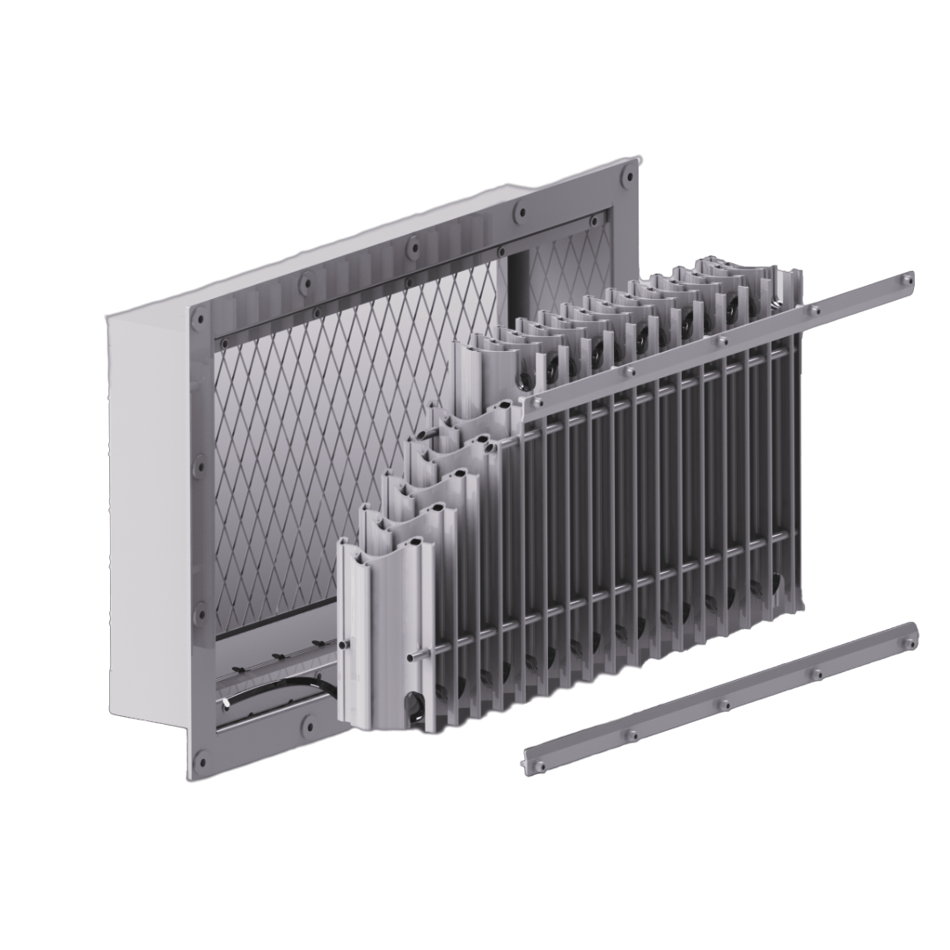
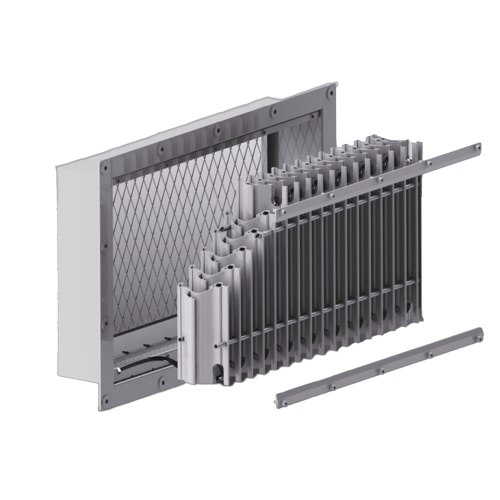
A droplet separator operates on a simple, reliable principle: inertia. It is a passive device with no moving parts, composed of a series of profiled vanes that force incoming air to change direction abruptly and repeatedly.
The lighter air molecules easily navigate the turns of the vane profiles. Heavier particles like water droplets and salt crystals cannot make these sharp turns. They maintain their trajectory, impact the vane surface, and are collected for removal from the airstream via a drainage system.
The effectiveness of the separator hinges on the vane profile design. The shape, spacing, and angle of the vanes are engineered to maximize water separation while minimizing resistance to airflow—a factor measured as pressure drop.
Important limitation: inertial separation is most effective for liquid water droplets of sufficient size. Fine mist, aerosols, and airborne moisture particles that are too small to be influenced by inertia will pass through. Separators do not capture these fine particles.
Droplet Separator Solutions
Water and Droplet Separators
The most common requirement in marine and coastal installations is protection from water—whether as rain or sea spray. A standard intake louver offers basic protection from driving rain, but a true droplet separator is an engineered product designed to capture the water droplets that standard louvers allow to pass through.
Separation efficiency is the critical metric. We design high-performance droplet separators, including the Alupro WS series, which are independently tested at the VTT Technical Research Centre of Finland according to EN 13030:2001. This provides certified performance data so you know exactly how the equipment will perform.
For systems where energy efficiency is paramount, our Alupro WSX High-Performance Droplet Separator is engineered for high water separation efficiency while maintaining a very low pressure drop, even at high air velocities.
Specialized Solutions for Extreme Environments: Heated Separators
What happens when a droplet separator operates in sub-zero conditions? The captured water freezes, forming a block of ice that chokes off airflow. This is a common failure point in arctic and sub-arctic applications.
The solution is our WST Water Droplet Separator — Heated. It features heated vanes that prevent ice and snow accumulation. Built from marine-grade aluminum or stainless steel, it ensures continuous airflow when it is needed most and is designed for decades of reliable, maintenance-free operation.
Key Factors in Selecting a Droplet Separator
Separation Efficiency
A measure of how effectively the separator removes liquid water droplets, expressed as a percentage for a specific droplet size and air velocity. Insist on certified data from independent tests. Our Alupro Marine solutions are engineered to capture up to 99.9% of water droplets.
Pressure Drop
The resistance the separator adds to the airflow. High pressure drop forces the system fan to consume more energy. The ideal separator provides the highest efficiency for the lowest possible pressure drop. This is the key trade-off in separator engineering, where advanced profiles like those in the WSX model deliver a competitive advantage.
Face Velocity
The speed of the air entering the separator. Performance is directly tied to velocity; a separator only performs as specified within its designed velocity range. A common mistake is undersizing a separator to save space or cost, which increases face velocity and reduces separation efficiency.
Material and Construction
The separator must be built to survive its operating environment. For marine and coastal use, we exclusively recommend marine-grade aluminum (WS, WST, WSX) or stainless steel (WS, WST) for their superior corrosion resistance.
Customization and Integration
Complex projects rarely allow for off-the-shelf components. All our separators are made-to-measure, engineered to fit specific openings. Seamless integration with the surrounding structure is crucial for performance and weathertightness.
Investing in Protection is Investing in Performance
An HVAC droplet separator is a critical investment in the reliability, efficiency, and longevity of your entire HVAC system. Selecting the right solution means looking beyond the initial price to evaluate certified performance data, pressure drop characteristics, and material specifications.
For complex industrial or marine projects, partnering with a specialist is essential. Contact us directly to discuss your project's unique requirements.
Frequently Asked Questions
What is the difference between a louver and a droplet separator?
A standard weather louver offers basic protection from driving rain and acts as a visual screen. A droplet separator is a high-performance engineering product that uses complex, aerodynamic profiles to capture liquid water droplets from the airstream with high efficiency. Note that neither a louver nor a droplet separator is designed to capture fine mist, aerosols, or very small airborne moisture particles.
How much pressure drop does a droplet separator add?
This varies with the separator's design and the air velocity. A well-designed separator, like our Alupro WSX, is engineered for the lowest possible pressure drop in its efficiency class. We provide detailed performance data for every model.
Can a droplet separator be retrofitted to an existing HVAC system?
Yes. Retrofitting is a common and effective method for resolving recurring moisture issues in existing HVAC systems. Because our separators are made-to-measure, we can engineer a unit to fit any existing intake opening or duct section.
What maintenance do your droplet separators require?
Our separators are designed to be maintenance-free. The WST heated model actively prevents ice buildup. Other models made from marine-grade aluminum or stainless steel are highly resistant to corrosion. Periodic visual inspection during general HVAC system checks is good practice, but no routine servicing or parts replacement is required.
How do I choose the right material for my separator?
The operating environment is the deciding factor. For marine, offshore, and most coastal applications, we recommend marine-grade aluminum (available in WS, WST, WSX) for its excellent corrosion resistance and favorable strength-to-weight ratio. For environments with specific chemical exposures, stainless steel (WS, WST) is the superior choice.
Do you provide performance data for your separators?
Yes. All our high-performance separators, including the WS and WSX series, have been independently tested at the VTT Technical Research Centre of Finland according to the EN 13030:2001 standard. We provide complete test reports and performance curves detailing separation efficiency and pressure drop across a range of face velocities.
Blog comments