
Selecting the right AHU air intake louver is a critical engineering decision that directly impacts...
How a droplet eliminator works: the engineering behind dry air
How a Droplet Eliminator Works: The Engineering Behind Dry Air
In heavy industry, marine environments, and power generation, intake air can be saturated with water droplets, salt spray, or rain. If this moisture enters a ventilation system, it corrodes components, damages sensitive electronics, and risks equipment failure. The solution is not a simple cover but a precisely engineered device: the droplet eliminator.
As engineers designing these systems daily, we know the difference between a standard model and a high-performance unit is in the engineering details. While the core function is always separating liquid water from air, success depends on mastering fluid dynamics, material science, and the specific application environment.
The Core Principle: Inertial Separation Explained
A droplet eliminator operates on the principle of inertial separation. Like a passenger feeling pushed outward during a sharp turn in a car, water droplets in an airstream resist changes in direction due to their mass.
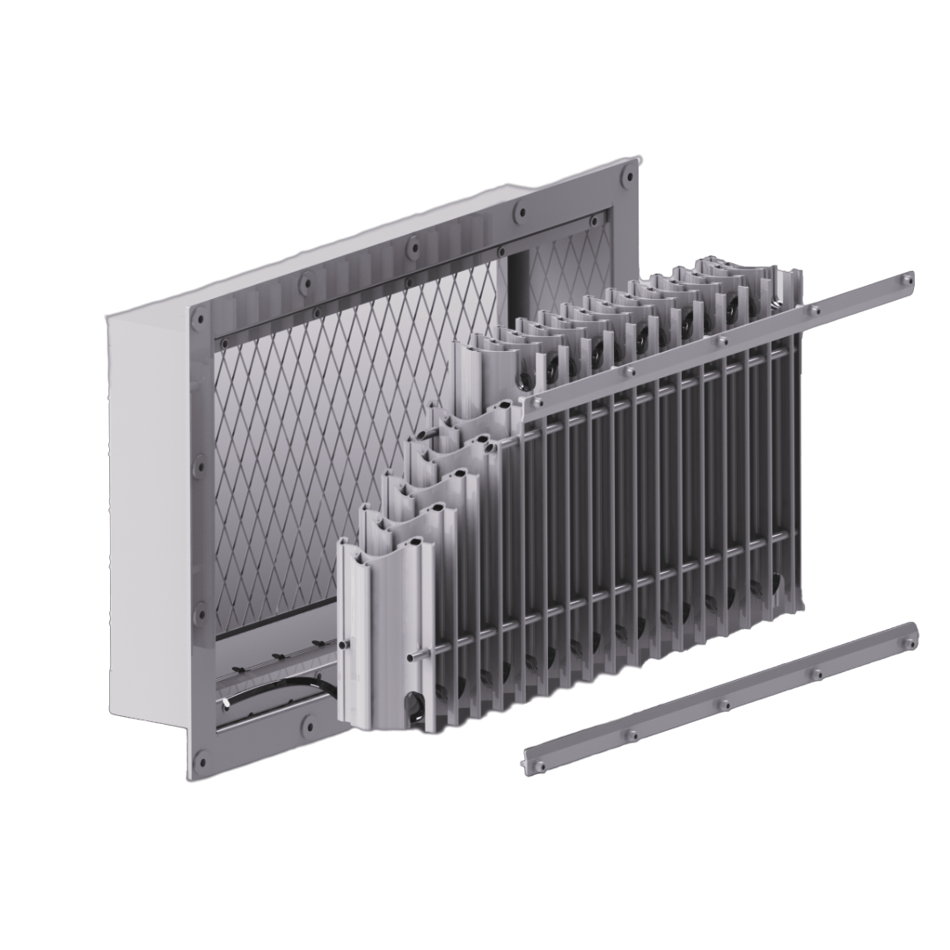
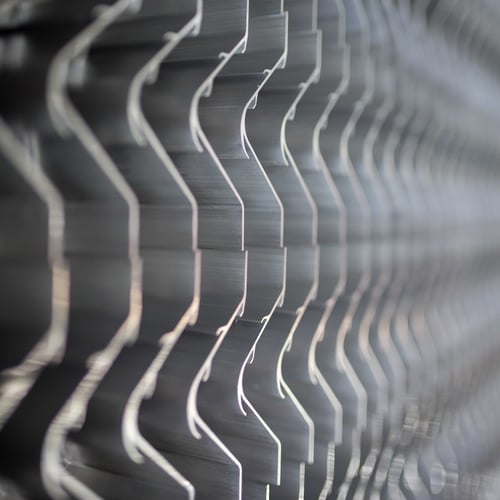
The eliminator consists of specially shaped profiles, or vanes, that force the air to follow a sharp, serpentine path. The light air molecules negotiate the turns easily. The heavier, denser water droplets cannot change direction as quickly. Their inertia carries them in a straighter line, causing them to collide and coalesce on the vane surfaces.
Once captured, gravity pulls the coalesced water down the profiles into a collection channel, where it is drained safely away from the system. The result is an airstream on the outlet side that is virtually free of liquid water droplets.
Important limitation: inertial separation is effective for liquid water droplets of sufficient size. Very fine mist, aerosols, or airborne moisture particles too small to be affected by inertia will not be captured. Similarly, wind-driven snow in suspension cannot be separated by this principle.
What Defines a High-Performance Droplet Eliminator?
While the principle is simple, achieving high separation efficiency without compromising the overall HVAC system requires sophisticated design.
Profile Design: The Secret to Efficiency
The geometry of the separator's vanes is the most critical design element. A simple bent plate might capture some water, but it allows significant bypass and is prone to re-entrainment—where captured water is sheared off the vane and picked up again by the airflow.
High-performance profiles, like those in our WSX High Performance Droplet Separator, use complex geometries with carefully angled hooks and pockets. These features create low-pressure zones that securely trap captured water, preventing it from re-entering the airstream. This design enables the separator to handle much higher air velocities while maintaining exceptional separation efficiency.
The Balancing Act: Separation Efficiency vs. Pressure Drop
Droplet eliminator design is a balancing act between separation efficiency and pressure drop. Any object in an airstream creates resistance, or pressure drop, which forces the system's fans to work harder and consume more energy.
An overly dense or complex vane profile might capture more water at the cost of a high pressure drop. Our design target is to optimize the profile for the highest possible separation efficiency with the lowest possible pressure drop. Our solutions are tested at the VTT Technical Research Centre of Finland according to EN 13030:2001/1 and ISO 5135:1997, providing verified data on the efficiency-to-pressure-drop ratio.
Material Selection and Durability
The operating environment dictates the material selection.
- Marine-Grade Aluminium: For most marine and industrial applications, we specify marine-grade aluminium. Its light weight is a major advantage on vessels, and it provides excellent corrosion resistance against salt spray. Our WS, WST, and WSX models are all available in marine-grade aluminium.
- Stainless Steel: In the most extreme environments, such as chemical processing plants or where galvanic corrosion is a risk, stainless steel is the superior choice. We manufacture our WS and WST Droplet Separators from stainless steel for maximum durability in these applications.
Application-Specific Engineering: Solving Real-World Challenges
An effective droplet eliminator is tailored to the unique challenges of each application.
The Marine and Offshore Challenge: Salt Spray and High Stakes
On ships and offshore platforms, air intakes face a constant bombardment of corrosive salt spray. Protecting critical navigation equipment, engines, and crew quarters is paramount. Our Alupro Marine solutions are engineered to remove over 99.9% of airborne water droplets, creating a dry, safe operational zone behind the separator.
Extreme Cold: The Problem of Icing
In arctic conditions, the challenge shifts from water to ice. A standard droplet eliminator can become completely blocked by snow and frozen spray, starving engines and ventilation systems of air.
Our solution is the heated WST Water Droplet Separator. The core of this design is a heating element running through the vanes, keeping the surface temperature above freezing. This system prevents ice and snow from accumulating and ensures unrestricted airflow, even in harsh arctic conditions. Built from marine-grade aluminium or stainless steel, these units are designed to be maintenance-free—a crucial feature for equipment in remote or inaccessible locations.
The Importance of Customization and Integration
Our experience shows that a droplet eliminator performs best when designed as an integral part of the air handling system, not as a standalone component. All our eliminators are made to measure, ensuring a perfect fit into the designated aperture.
We often integrate them into complete assemblies that include weather louvres, panel filters, and custom casings. Whether you are designing a new ventilation system for a naval vessel or retrofitting an industrial plant, the right droplet separation technology is critical.
Contact us to discuss the specific requirements of your project. Our engineering team is ready to help you analyze your needs and design a solution that delivers the dry air your application demands.
Frequently Asked Questions
How do I choose the right droplet eliminator?
To specify the right eliminator, we analyze several factors: the required air velocity, acceptable pressure drop, expected droplet size, and the corrosiveness of the environment. We work with clients to evaluate these variables and engineer a separator that provides the necessary protection without wasting energy or exceeding budget.
What is pressure drop and why is it important?
Pressure drop is the airflow resistance the separator creates. A lower pressure drop means the system's fans require less power. This translates directly into significant energy savings over the system's lifespan. Our designs balance high separation efficiency with minimal pressure drop.
Can droplet eliminators be used in freezing temperatures?
Standard models can become clogged with ice and snow in sub-zero conditions. For these applications, a heated solution is necessary to prevent icing. Our WST Heated Droplet Separator uses heated vanes to prevent ice and snow accumulation, ensuring continuous and unrestricted airflow in arctic conditions.
What maintenance do droplet eliminators require?
Our separators are designed to be maintenance-free. The WST heated models actively prevent ice buildup. Standard models are built from corrosion-resistant materials with smooth vane surfaces that promote effective water drainage. Periodic inspection is good practice, but our separators require no routine servicing.
What is the difference between aluminum and stainless steel models?
Marine-grade aluminum is lightweight and highly resistant to salt spray corrosion, making it ideal for most marine and coastal applications (WS, WST, WSX). Stainless steel provides superior durability in highly corrosive environments (available in WS and WST models). The choice is driven by the application.
How is separation efficiency measured?
We measure separation efficiency according to rigorous industry standards. Our droplet separators are independently tested at the VTT Technical Research Centre of Finland per EN 13030:2001/1 and ISO 5135:1997. This testing quantifies water rejection effectiveness at various air velocities, providing clients with verified, reliable performance data.
Blog comments