


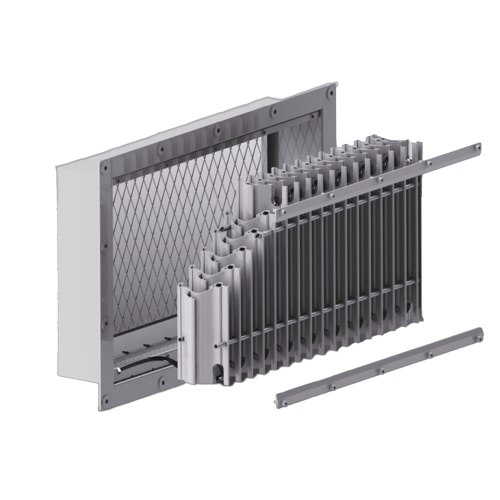
Modern HVAC systems are integral to critical infrastructure, from offshore platforms and power...
A guide to AHU air intake louvers: balancing pressure drop and weather protection
Selecting the right AHU air intake louver is a critical engineering decision that directly impacts HVAC system performance. The core challenge is a trade-off: the air handling unit requires a steady flow of fresh air, but the system's internal components must be protected from rain, snow, debris, and salt spray. A mistake here risks everything from spiraling energy costs to equipment failure.
From our experience designing solutions for demanding climates, the intake louver is not a minor component—it is foundational to the system's performance and resilience. A simple stamped grille may look adequate on paper, but in a real-world storm, it becomes a significant liability.
This guide examines the core principles of louver selection from an engineer's perspective, focusing on how blade design, environmental factors, and a system-level approach determine the success of an AHU intake.
The Fundamental Trade-Off: Pressure Drop vs. Weather Protection
Every louver specification is a negotiation between two opposing needs: airflow efficiency (low pressure drop) and system protection (high weather effectiveness). Understanding this conflict is the key to making an informed choice.
What Exactly Is Pressure Drop?
Pressure drop is the resistance air encounters as it passes through the louver. Every bend and surface in the airflow path creates friction. To overcome this, the AHU's fan must work harder and draw more power to pull in the required volume of air.
A high pressure drop translates directly to higher operational costs. A fan running against unnecessary resistance consumes more electricity, 24/7, adding up to significant expense over the installation's lifespan.
Why Weather Protection Is Non-Negotiable
Weather protection is a louver's ability to stop external elements—primarily water from wind-driven rain or snow—from entering the AHU. When water penetrates an AHU, the consequences are severe:
- Component Damage: Moisture corrodes coils, damages fan motors, and clogs filters.
- Reduced Efficiency: Wet filters increase pressure drop and reduce airflow. In cold climates, moisture can freeze on coils, blocking the system entirely.
- Structural Damage: In severe storms, significant water ingress can damage the plant room itself.
Standard louvers are typically tested against simple vertical rainfall. In coastal or northern regions, wind-driven rain and snow behave very differently and demand a more sophisticated approach.
How Louver Design Impacts Performance
The performance of an AHU air intake louver is a direct function of its geometry. Minor changes to the shape and spacing of the blades have a massive impact on both pressure drop and water rejection.
Blade Profile and Spacing
- Simple, flat blades: Low resistance and low pressure drop, but minimal protection against wind-driven rain.
- Chevron or 'S' shaped blades: Create a more tortuous path, causing heavier water droplets to lose momentum and drain away. The more aggressive the profile, the better the weather protection, but the higher the pressure drop.
- High-performance profiles: Engineered to capture water droplets with maximum efficiency while keeping the airflow path as smooth as possible.
The Importance of Drainage
Blocking water is not enough; it must be managed. Effective louvers incorporate collection channels into each blade and a robust sill drainage system. As water is captured, it runs into these channels and drains out at the front of the louver. Without effective drainage, captured water can be pulled back into the airstream, defeating the louver's purpose.
Understanding Performance Classes (EN 13030)
The European standard EN 13030 provides a baseline for comparing louver performance. It tests two key metrics:
- Water Penetration Effectiveness: Louvers are subjected to simulated wind and rain and rated by class, with Class A representing the highest level of performance.
- Pressure Drop Coefficient: Louvers are tested for air resistance, with a discharge coefficient indicating aerodynamic efficiency.
While these classes are a good starting point, they are conducted under specific lab conditions that do not account for real-world factors like sea spray or the unique challenges of snow and ice. Demanding environments require solutions engineered for those specific conditions.
Choosing the Right AHU Air Intake Louver for Your Environment
A louver that is perfect for an office in a mild, inland climate will fail on a North Sea oil rig or a facility in the Arctic Circle. The selection process must start with a realistic assessment of the project's environmental challenges.
Standard Commercial and Industrial Buildings
For most inland applications with moderate weather, a high-quality weather louver with a Class A water penetration rating is often sufficient. The key is to avoid undersizing the louver. A larger surface area reduces the intake air velocity, which dramatically improves the louver's ability to shed water.
Coastal and Marine Environments
Coastal areas introduce higher wind speeds and corrosive salt spray. Wind-driven rain is more forceful, and sea spray easily penetrates standard louvers. For these applications, we specify dedicated droplet separators instead of standard weather louvers.
Alupro Marine solutions are engineered with a separation process that removes up to 99.9% of water droplets. This level of performance is essential for protecting sensitive equipment on ships, offshore platforms, and coastal power plants. Material choice is equally critical: we use marine-grade aluminium or stainless steel with powder coating to provide proven durability in saline environments.
Cold and Arctic Climates
In cold regions, the biggest threat is ice. Snow, sleet, and freezing rain can build up on louver blades, constricting or completely blocking airflow. This can cause a critical failure, shutting down an entire HVAC system when it is needed most.
For these applications, a heated louver is the only reliable solution. Our WST Water Droplet Separator incorporates heated vanes that prevent ice and snow accumulation. These are robust, maintenance-free systems engineered to last for decades in facilities like icebreakers and northern power stations.
The Alupro Process: From Specification to Delivery
Optimal performance is not achieved by selecting a product from a catalog. It requires a collaborative process where the louver solution is engineered as an integral part of the system.
We work directly with HVAC engineers, project managers, and purchasing departments from the earliest design stages. Every louver and droplet separator we produce is made-to-measure for the specific project. This eliminates sizing compromises and ensures seamless functional integration.
Choosing the right AHU air intake louver is an engineering decision with long-term consequences for a system's energy efficiency, maintenance costs, and reliability. Contact our engineering team to discuss your project's specific requirements.
Frequently Asked Questions
What is the most important factor when choosing an AHU louver?
The single most important factor is the specific environmental conditions of the project site. A detailed analysis of expected rainfall, wind speeds, temperature range, and potential for snow or salt spray must guide the selection.
Can a high-performance louver also have a low pressure drop?
Yes, though it requires advanced design. High-performance louvers and droplet separators use aerodynamically optimized blade profiles that efficiently capture water while minimizing turbulence in the airstream.
How do I know if I need a heated louver?
We recommend a heated louver, like our WST series, in any location with a risk of freezing rain, wet snow, or temperatures fluctuating around 0°C that could cause ice to block airflow. If continuous AHU operation is critical during winter, a heated solution is a necessary measure against system failure.
What is the difference between a weather louver and a droplet separator?
A weather louver is designed to block direct, wind-driven rain. A droplet separator is a higher-performance device engineered to remove larger moisture particles—liquid water droplets—from the airstream using inertial separation. For marine, coastal, or high-humidity applications, a droplet separator is far more effective. Note that neither solution captures fine mist, aerosols, or very small airborne moisture particles.
What maintenance do AHU louvers require?
High-quality aluminium louvers require only periodic visual inspections to clear debris like leaves or other objects. Our WST heated louvers are engineered to be maintenance-free. The materials and construction are chosen for extreme durability, providing decades of reliable service.
Are your louvers available in custom sizes and colours?
Yes. All our louver and droplet separator solutions are custom-manufactured to the precise dimensions required for each project. We offer powder coating in a range of colours from the RAL chart to ensure the louvers integrate with the installation's requirements.


Blog comments